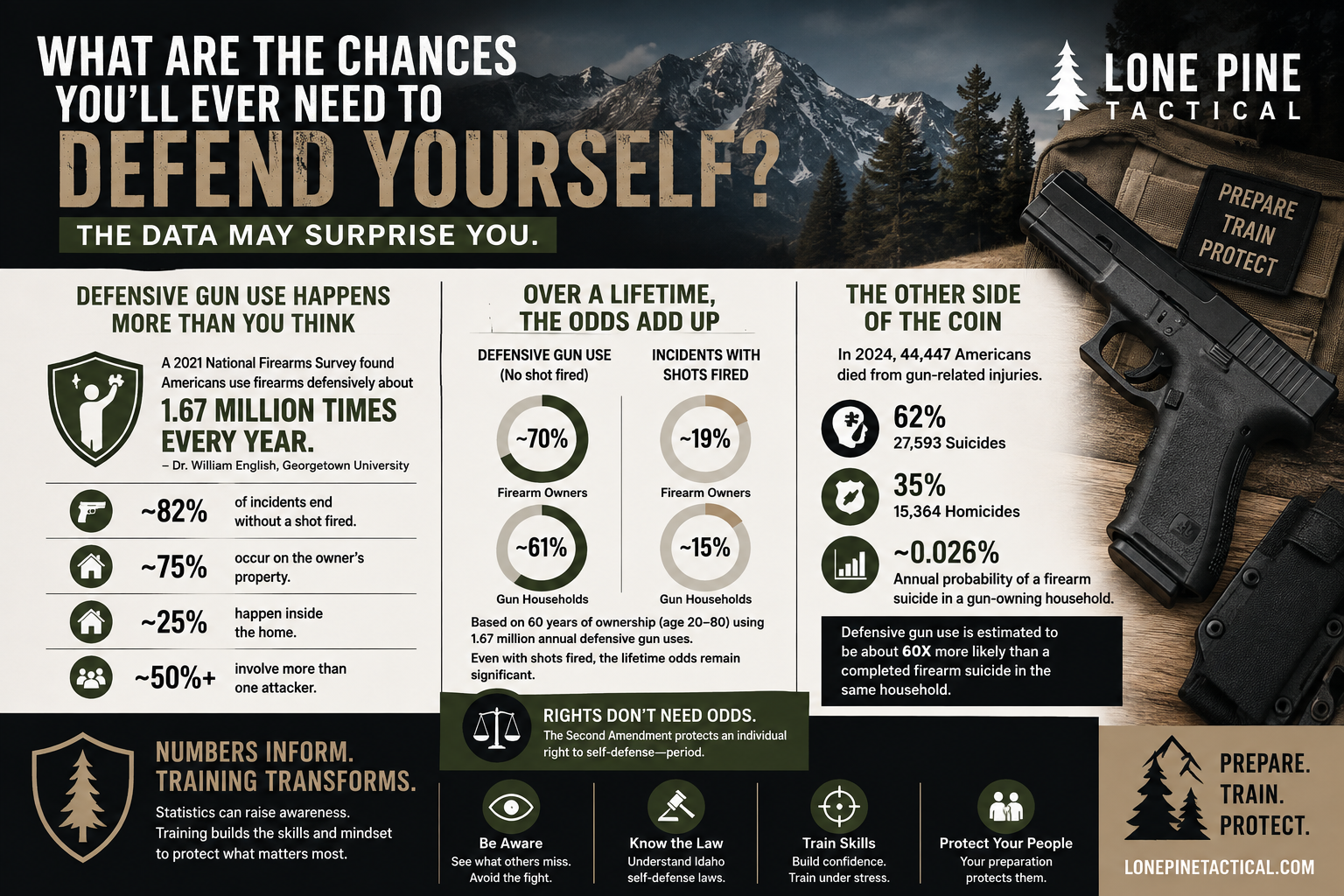
What Are the Chances You’ll Ever Need to Defend Yourself? The Data May Surprise You.
A firearm is a defensive tool - not something you hope to use, but something you hope to never have to use.
When Our Confidence Outlasts the Evidence
A phone call to 911 should be part of your emergency response plan—but it should never be your entire plan.
The reality is that police officers, firefighters, and EMS personnel often need time to respond, even when communications systems are functioning perfectly. During a large-scale outage or emergency, those delays can increase dramatically.
Prepared citizens understand that they are the true first responders to their own emergencies. They take reasonable steps to protect themselves and their families by developing skills, maintaining essential equipment, and thinking through potential scenarios before they happen.
Preparedness isn’t paranoia. It’s responsibility.

Concealed Carry Is Growing Across All Demographics
For years, many people assumed that concealed carry was primarily associated with a specific region, lifestyle, or political viewpoint. Recent research suggests the reality is much broader.
A survey conducted by the Crime Prevention Research Center (CPRC) and McLaughlin & Associates in May 2026 surveyed 1,000 likely voters to better understand concealed carry habits in America. The results revealed that Americans from a wide range of backgrounds, communities, and political perspectives are choosing to legally carry firearms for personal protection.
One of the most surprising findings was that individuals identifying as “very liberal” reported carrying concealed handguns at rates comparable to—and slightly higher than—those identifying as “very conservative.” The survey also found that concealed carry participation spans all demographic groups, including urban residents, minorities, and voters from across the political spectrum.
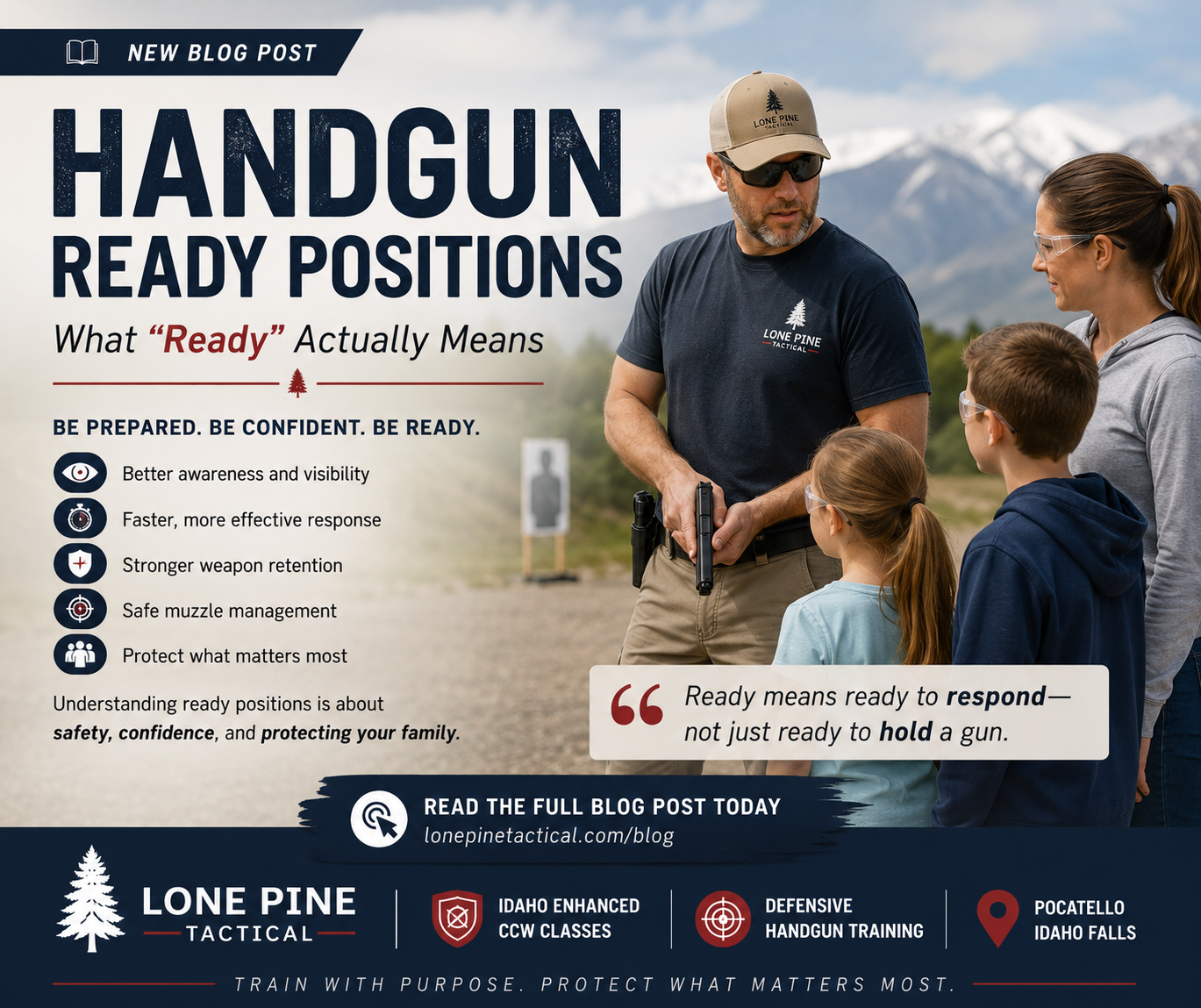
Handgun Ready Positions: What “Ready” Actually Means
When we talk about a ready position, we’re not just talking about having a gun in your hand. A true ready position means you are prepared—mentally and physically—to engage a threat with gunfire if required.
That standard carries responsibility. A proper ready position must balance speed, control, visibility, and legal defensibility.
What Defines a True Ready Position
A functional ready position must meet these criteria:
Ready means ready to engage a threat with gunfire
Not a relaxed or casual posture
Maintains full visibility downrange
Allows clear observation of hands and waistband
Supports weapon retention under stress
Does NOT muzzle a person unless you’ve made the decision to shoot
Behavioral Cues to Impending Aggression Why Awareness Without Interpretation Gets People Hurt
Key indicators of escalating aggression include:
Hands planted on hips (dominance display)
Head tilted or cocked (challenge posture)
Arms crossed tightly across the chest (defensive or confrontational)
Fists clenched or rhythmically tightening and relaxing
Jaw tightening or grinding
Spitting (high emotional escalation and contempt)
Avoiding eye contact in a deliberate way
Constant scanning of the environment
Repetitive verbal justifications (“I’m not going to let you…”, “You can’t…”)
Excessive yawning or stretching (adrenaline response)
Grooming behaviors (adjusting clothing, wiping hands, touching face)
Situational Awareness Isn’t Just “Paying Attention”Turning Observation Into Action
Turning Observation Into Action
For years, people have been told that situational awareness is simple:
Stay alert.
Look around.
Keep your head on a swivel.
Live in “condition yellow.”
It sounds responsible. It sounds tactical.
But it’s incomplete—and in many cases, ineffective.
Because paying attention isn’t a skill.
And it’s not a plan.
Real-World Lessons from a Recent Officer-Involved Shooting
At Lone Pine Tactical, we emphasize practical skills that hold up under pressure:
Accurate shot placement
Efficient weapon handling
Threat recognition
Movement and use of cover
Decision-making under stress
Medical readiness after violence
When real violence happens, there are no practice rounds. You perform at the level of your training.
Train With Purpose
If you carry a firearm for defense, protect your family, or serve professionally, regular training matters. Confidence comes from competence, and competence comes from repetition guided by proven instruction.
Train today so you’re prepared tomorrow.
The Miami Shootout: 40 Years Later — Lessons That Still Matter
On April 11, 2026, we mark the 40th anniversary of one of the most studied gunfights in modern American law enforcement history—the 1986 FBI Miami Shootout.
This was not just another incident. It was a defining moment that reshaped firearms training, ammunition development, and law enforcement tactics across the country.
Nine FBI agents engaged two highly motivated, heavily armed bank robbers in a brutal and prolonged gunfight. When it ended, both suspects were dead—but so were two FBI agents, with five others wounded.
It was a hard lesson paid for in blood.
And it changed everything.
Case Brief: The Michael Dunn Shooting
On November 23, 2012—Black Friday—what began as a routine stop at a convenience store in Jacksonville turned into a fatal encounter that would ultimately send a man to prison for life.
This case is a powerful study in decision-making under stress, escalation, and the legal boundaries of self-defense—all critical areas for responsible armed citizens.
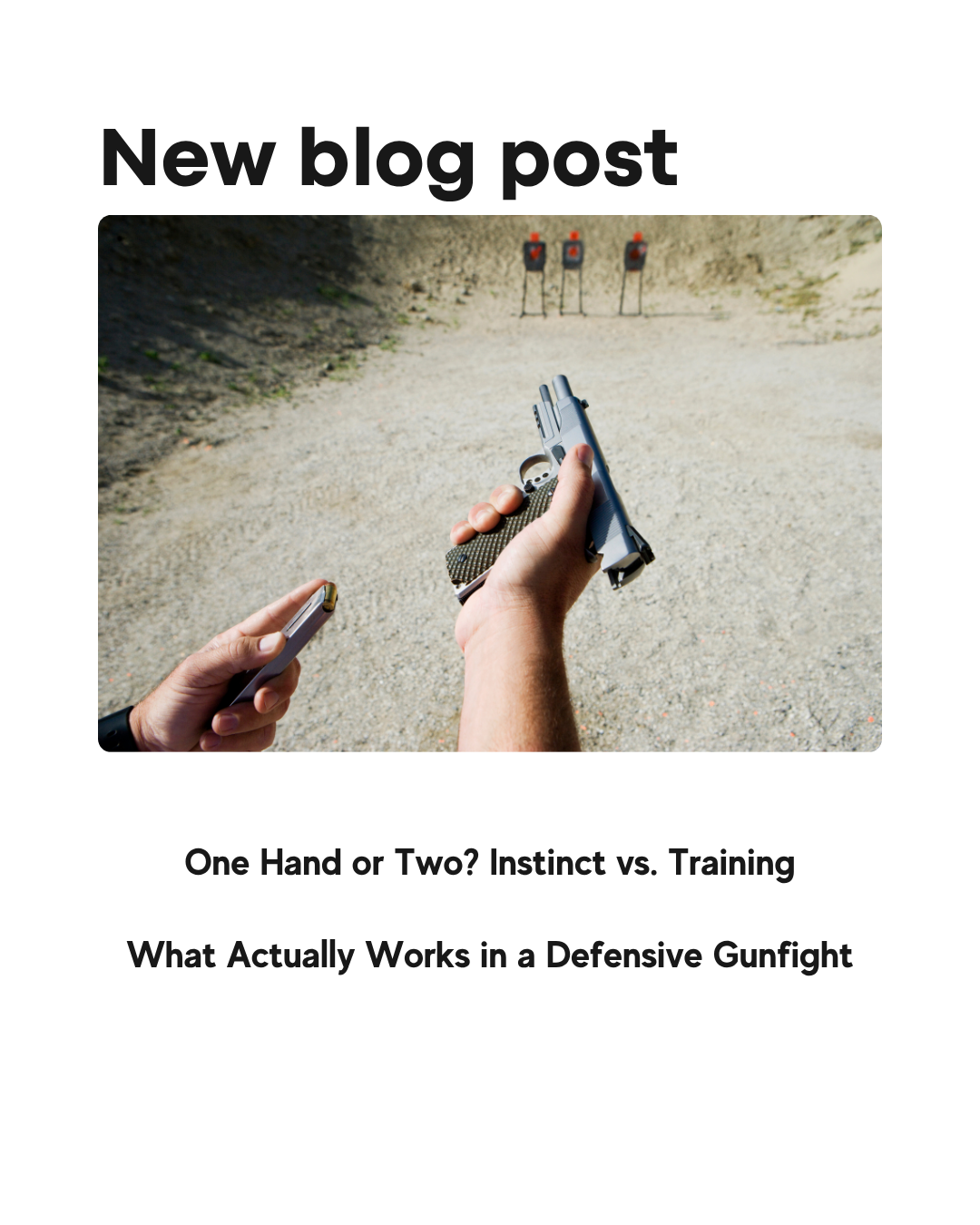
One Hand or Two? Instinct vs. Training What Actually Works in a Defensive Gunfight
One Hand or Two? Instinct vs. Training
What Actually Works in a Defensive Gunfight
A question that occasionally comes up in firearms training circles is whether shooters should default to one-handed shooting because it is “instinctive.”
It’s an interesting claim—but it doesn’t hold up when we look at how people actually perform in real defensive encounters.
There Is No “Instinctive” Way to Use a Firearm
When Seconds Count: Why Calling 911 Isn’t Always Enough
The next time someone claims, “You don’t need to carry— just call 911,” share these eye-opening facts from recent years. Police response times remain strained due to ongoing staffing shortages, and the reality on the ground hasn’t improved much since 2023.
Situational Awareness: Mastering Space, Time, and Self
Too many discussions about situational awareness boil down to “just pay attention” or “stay alert.” That’s like telling a new shooter to “be accurate.” It’s well-meaning but useless—no structure, no drill, no path to get better.
Situational awareness isn’t a vague mindset, a personality type, or a color code on a mental chart. It’s a concrete skill you build deliberately, test under pressure, and maintain through consistent practice.
Shooting Incidents: Common Factors Across Real-World Encounters
The bottom line: WEAR YOUR GUN! Carry consistently—because the day you need it most is the day you least expect it. These real-world patterns underscore why we train for close-range, rapid presentations, multiple threats, and decisive hits under stress.
Exceptions exist (e.g., rare longer-range engagements), so build versatile skills: speed at close quarters and precision when distance increases. Train realistically, stay aware, and stay prepared.
Questions or ready to level up your training? Reach out—we’re here to help you meet the realities of self-defense head-on. Stay safe out there.
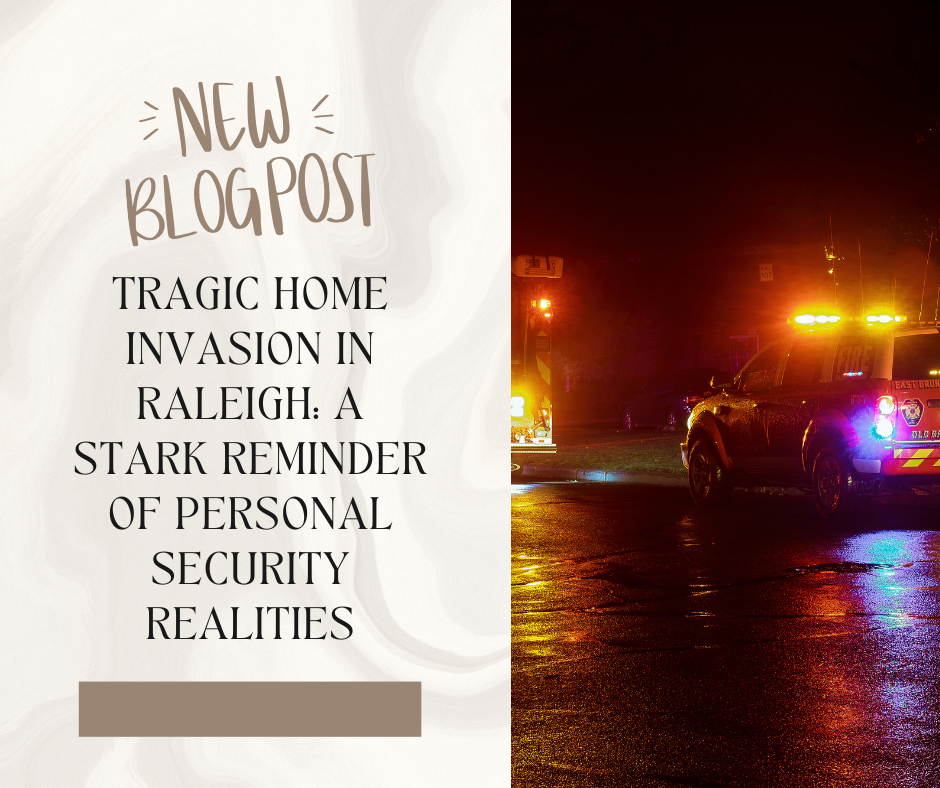
Tragic Home Invasion in Raleigh: A Stark Reminder of Personal Security Realities
On January 3, 2026, in Raleigh, North Carolina, a beloved science teacher and department chair at Ravenscroft School, Zoe Welsh, was fatally assaulted in her own home during an early morning burglary. Around 6:30 a.m., Welsh discovered an intruder in her residence on Clay Street and immediately called 911 to report the break-in. Tragically, while she was still on the line with dispatchers, the suspect began attacking her. By the time police arrived minutes later, she had sustained life-threatening injuries and was rushed to the hospital, where she later died.

The Decision Engine: Four Simple Questions That Can Save Your Life
At Lone Pine Tactical, we emphasize practical, real-world skills that go beyond the range—skills rooted in awareness, movement, and smart decision-making under stress. One particularly valuable concept we’ve incorporated into our training draws from advanced courses like “Take-A-Seat,” which focuses on effectively fighting from seated positions (such as in vehicles, restaurants, or on the ground), defending against close-quarters threats while seated, and rapidly transitioning back up to your feet to re-enter the fight.
A standout element from this type of training is a powerful post-engagement sequence: a straightforward mental checklist for the chaotic moments after neutralizing an immediate threat.
It consists of four simple questions:
1. Who can help me?
2. Who can hurt me?
3. Where am I going?
4. Where are my people?

Beware the Shod Foot: A Deadly Reminder of Ground-Fight Realities
Beware the Shod Foot: A Deadly Reminder of Ground-Fight Realities
Train for the Worst—Because It Happens
Incidents like this underscore why we train ground fighting, multiple threats, and disadvantaged-position shooting at Lone Pine Tactical. Our Defensive Handgun and Advanced courses include drills for drawing/shooting from the ground, retaining your firearm in clinches, and managing multi-assailant scenarios.
Violence Strikes Without Warning: Choose Readiness Over Regret
At Lone Pine Tactical, we don’t sugarcoat reality: Violence doesn’t send invitations. It erupts anywhere, anytime, against anyone. Accepting this truth is the first step toward taking control of your personal safety.
You may be selected as a victim without consent—but becoming victimized? That’s where you draw the line. Preparation turns the tables.
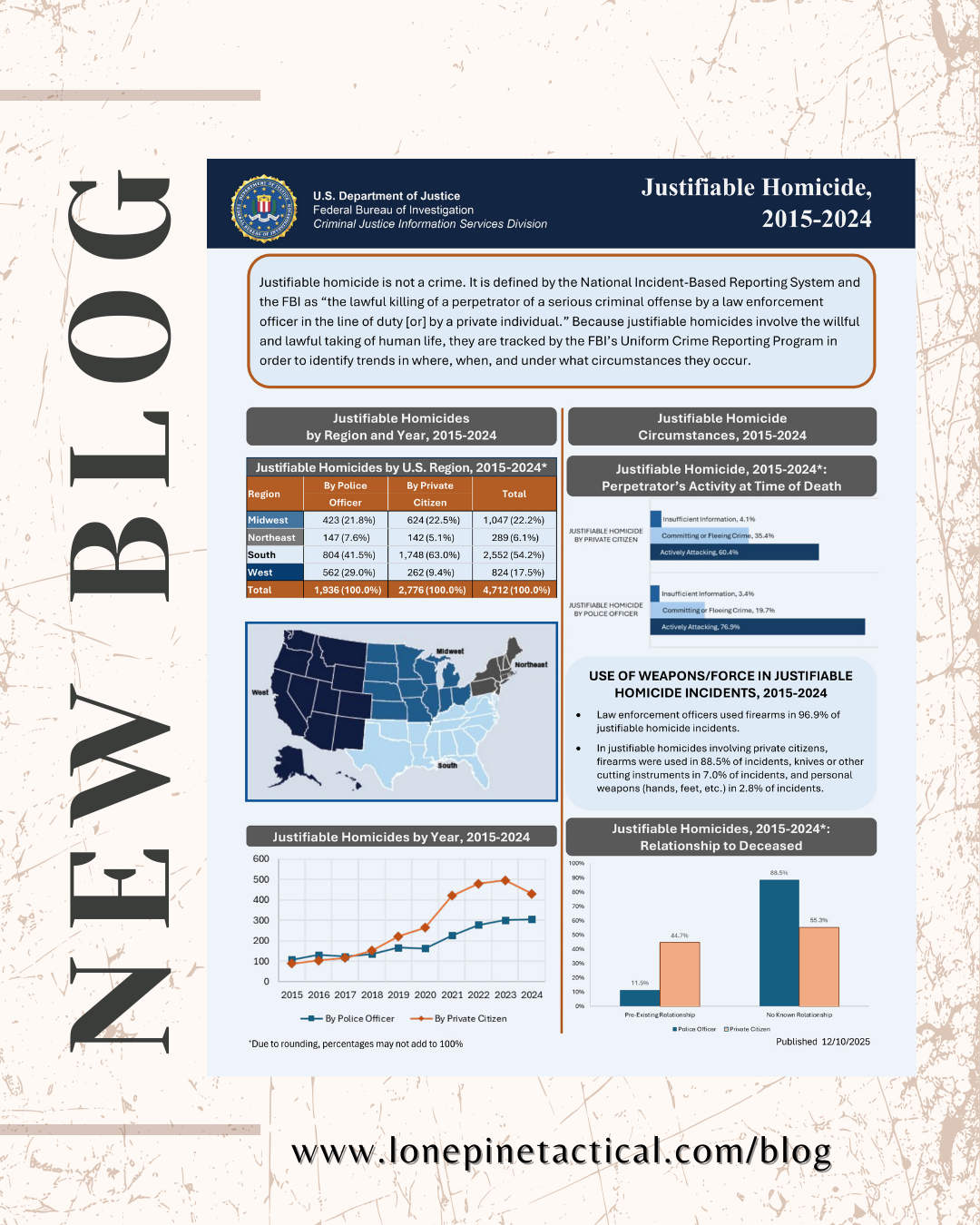
Here is the latest FBI report on justifiable homicides in the US, both by police and by private citizens.
Justifiable Homicide 2015-2024
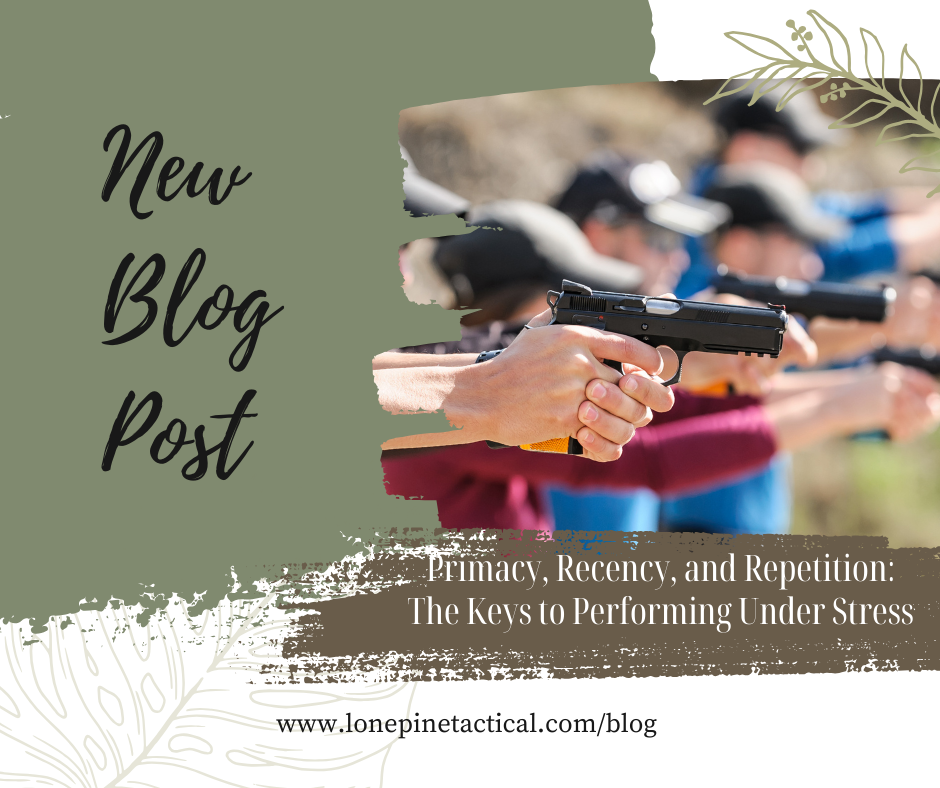
Primacy, Recency, and Repetition: The Keys to Performing Under Stress
In motor skill development—especially the high-stakes skills needed for defensive handgun use—three principles stand out: Primacy, Recency, and Repetition
Distances in Real-World Self-Defense Shootings: What the Data Actually Shows
Distances in Real-World Self-Defense Shootings: What the Data Actually Shows
For years, many civilian defensive-firearms courses have leaned heavily on police-oriented statistics, especially the FBI’s Law Enforcement Officers Killed and Assaulted (LEOKA) reports. The problem? Most police shootings involve uniformed patrol officers conducting high-risk activities that armed citizens almost never face—felony traffic stops, responding to hold-up alarms, domestic violence calls, serving warrants, and so on.
Those scenarios are fundamentally different from the environment a concealed-carrying citizen operates in: plain clothes, concealed handgun, unmarked (usually personal) vehicle, and no legal authority to detain or pursue.